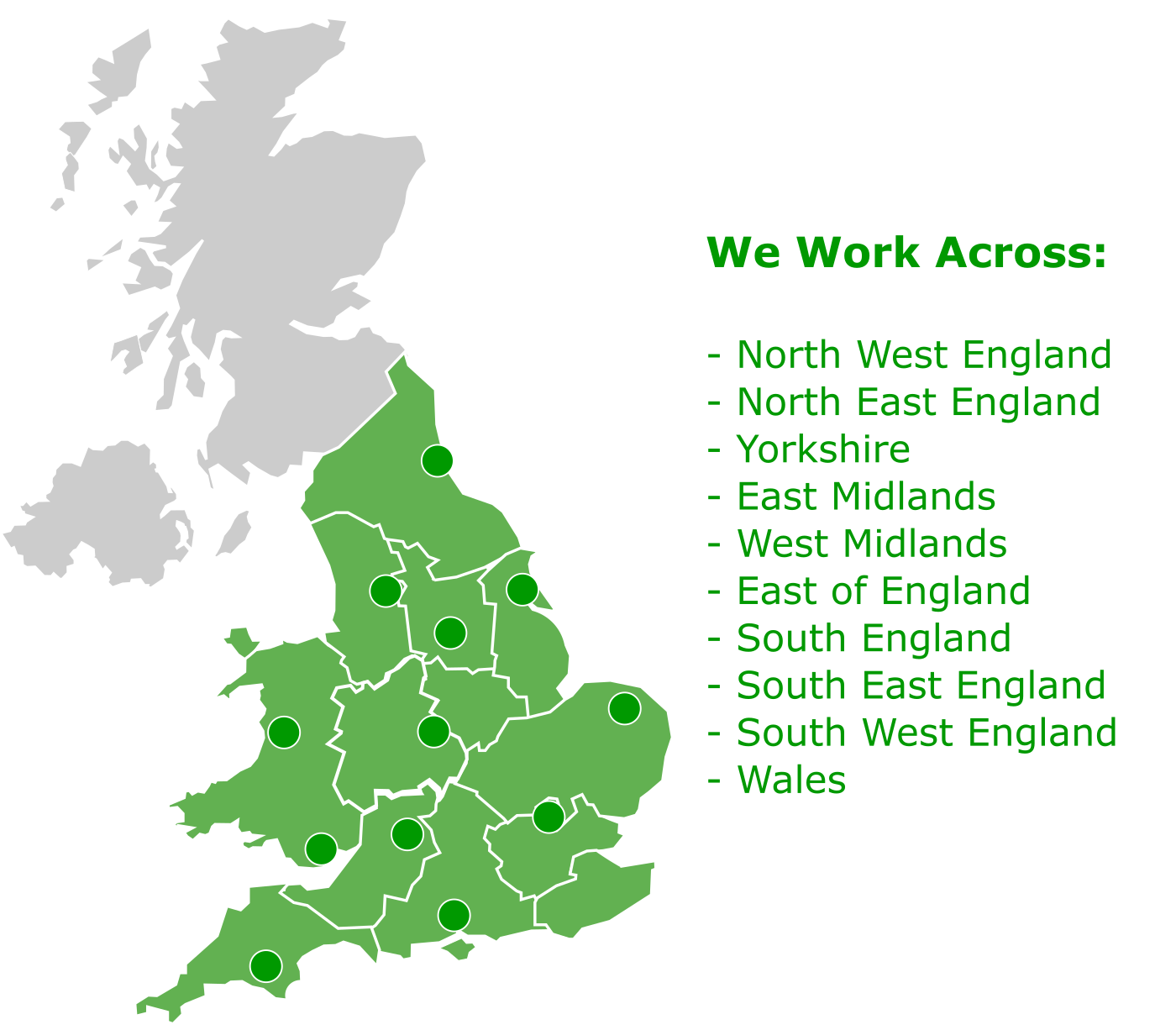
Green Business Light are an energy efficient industrial & commercial LED lighting installation company. We work direct with clients who occupy large buildings, such as:
Warehouse & Storage Buildings
Industrial Sites & Factories
Sports Halls & Leisure Facilities
Exhibition Centres
Our LED lighting systems slash the running costs of typical high bay & low bay light fixtures by up to 80 %
test | ||
Markdown example start
This is a bold word, and this is italic.
A List of Things
- First item
- Second item
- Third item with a link to Statamic
Lighting Lux Levels in Warehouses: 2025 UK Guide for Safety, Efficiency & Compliance
Proper warehouse lighting is one of the most critical factors in maintaining safety, productivity, and energy efficiency. Warehouse lux levels affect how clearly staff can see aisles, racking, labels, and hazards. Poor lighting can cause accidents, picking errors, and unnecessary energy consumption.
At Green Business Light, we help UK warehouses optimise their lighting with LED warehouse lighting solutions that meet warehouse lighting standards and improve warehouse lighting efficiency.
Book a free warehouse lighting survey to assess your current setup and discover savings opportunities.
What Are Lux Levels?
Lux (lx) is the unit of illuminance, measuring how much light falls on a surface. One lux equals one lumen per square metre.
Understanding lighting levels in warehouses is essential because proper illuminance ensures staff can work safely and accurately. Following CIBSE lighting standards and HSE warehouse lighting guidelines helps organisations comply with UK regulations and maintain energy efficiency.
Why Lux Matters
- Safety: Prevent slips, trips, and collisions.
- Accuracy: Reduce picking errors and product damage.
- Efficiency: Avoid over-lighting and wasted energy.
- Compliance: Adhere to HSE and ISO requirements.
HSE guidance states lighting should be “suitable and sufficient for the task, without causing glare or shadowing.” (HSE HSG38)
Recommended Lux Levels Table
Different warehouse zones have unique lighting requirements. Below is a lux level guide for warehouses based on CIBSE LG1 and best practice:
| Warehouse Area | Recommended Lux (lx) | Purpose / Notes |
|---|---|---|
| Bulk storage (unmanned aisles) | 100 | Minimum level for safe navigation |
| Manned aisles (forklift traffic) | 150–200 | Supports visibility for drivers and pedestrians |
| Racking faces / picking aisles | 200–300 | Allows accurate label reading |
| Packing & dispatch areas | 300 | Task lighting for detailed work |
| Loading bays | 300–500 | High illumination for safe loading/unloading |
| Office/admin zones within warehouse | 300–500 | Standard office lighting conditions |
Tip: Aim for uniformity of at least 0.4 (minimum lux ÷ average lux) to avoid shadows and dark spots.
Signs You Need a Warehouse Lighting Upgrade
Common indicators that your warehouse requires a lighting upgrade:
- Uneven lighting or frequent shadows across aisles
- Flickering lamps or high maintenance requirements
- Rising electricity bills
- Poor visibility for forklifts or staff
- Complaints about eye strain or fatigue
- Non-compliance with warehouse light level standards
- High energy consumption without measurable output
Book your free warehouse lighting survey today to identify areas for improvement.
How to Measure Lux Levels – Warehouse Lighting Survey
A warehouse lighting survey measures current illuminance and identifies opportunities for improvement.
Step 1: Define Measurement Zones
- Storage aisles
- Racking faces
- Packing stations
- Loading docks
- Circulation corridors
Step 2: Use a Calibrated Lux Meter
Take readings at floor level for horizontal light and eye height for vertical illuminance. Record multiple points per zone to calculate an average.
Step 3: Record Supporting Data
Document fixture types, wattage, mounting height, lamp age, and control systems.
Step 4: Calculate Uniformity
Uniformity = minimum lux ÷ average lux. Aim for 0.4–0.6 to prevent uneven light.
Step 5: Compare Against Standards
Reference CIBSE LG1, HSE HSG38, and BS EN 12464-1 for target lux levels.
Step 6: Compile Audit Report
Include:
- Current vs target lux
- Energy consumption (kWh/year)
- Maintenance costs
- Retrofit or redesign recommendations
- Payback and ROI analysis
Benefits of Upgrading to LED Warehouse Lighting
1. Energy Savings
- LEDs use up to 70% less energy than metal halide or fluorescent systems
- Combined with sensors, savings can exceed 80%
- Example: A 10,000 m² warehouse could reduce energy consumption from 400,000 kWh/year to under 150,000 kWh/year
2. Lower Maintenance Costs
LEDs last 50,000–100,000 hours, reducing replacements and downtime.
3. Improved Safety and Productivity
Consistent illumination reduces accidents and increases picking accuracy.
4. Sustainability and ESG
Reduced carbon emissions (~0.4 kg CO₂ per kWh saved). Supports ISO 14001 and corporate ESG targets.
5. Fast Payback
Typical payback period: 2–4 years, depending on size and usage.
Discover potential savings – book a free survey
LED Design Considerations
- Fixture type: Use LED high bay lighting for ceilings above 8 m; linear LEDs for aisles
- Beam angle: Select based on racking height and aisle width
- Color temperature & CRI: 4000–5000K, CRI >80 for accurate colour perception
- Lighting controls: Presence and daylight sensors optimize energy usage
- Maintenance planning: Schedule cleaning and periodic lux measurement
- Compliance: Align with CIBSE LG1, BS EN 12464-1, HSE HSG38
Case Study: LED Retrofit Warehouse Project
Client: 20,000 m² logistics warehouse, Midlands
| Metric | Before Upgrade | After LED Retrofit |
|---|---|---|
| Power per fixture (W) | 400 | 200 |
| Annual energy use (kWh) | 360,000 | 180,000 |
| Annual cost (£) | 54,000 | 27,000 |
| CO₂ emissions (tonnes) | 144 | 72 |
| Payback period | - | 3.2 years |
Outcome: Lux levels increased from 150 lx to 280 lx in picking aisles. Uniformity improved by 40%. Annual savings: £27,000 and 72 tonnes CO₂ avoided.
Learn more about Green Business Light projects
Compliance and Warehouse Lighting Standards
| Standard / Guide | Purpose | Link |
|---|---|---|
| CIBSE LG1 | Industrial lighting design guidance | Link |
| BS EN 12464-1 | Workplace indoor lighting requirements | Link |
| HSE HSG38 | Lighting at work guidance | Link |
| ISO 14001 | Environmental management framework | Link |
FAQ – Warehouse Lighting Requirements UK
1. What are the minimum warehouse lux levels?
Storage: 100 lx
Manned aisles: 150–200 lx
Picking zones: 200–300 lx
Loading bays: 300–500 lx
2. Are lux levels legally enforced?
Indirectly — HSE requires lighting to be “suitable and sufficient” under UK Workplace Regulations.
3. How often should a lighting audit be performed?
Every 3–5 years or when racking layouts change.
4. How much can LED lighting save?
Typically 50–70% energy reduction, more with sensors.
5. Can I retrofit LEDs into existing fittings?
Yes, if wiring and structure are compatible.
6. What is the average payback for LED upgrades?
2–4 years, depending on warehouse size and energy usage.
7. How can lighting performance be maintained?
Regular cleaning, sensor calibration, and warehouse lighting surveys.
Conclusion – Lighting That Works as Hard as You Do
Proper warehouse lux levels improve safety, productivity, and sustainability. Investing in LED high bay lighting with professional warehouse lighting design delivers:
- Up to 70% energy savings
- Significant CO₂ reduction
- Safer, more productive working environment
Book your free warehouse lighting survey with Green Business Light today.
LED Retrofit Solutions | Warehouse Lighting Design Service | Energy Saving Audits